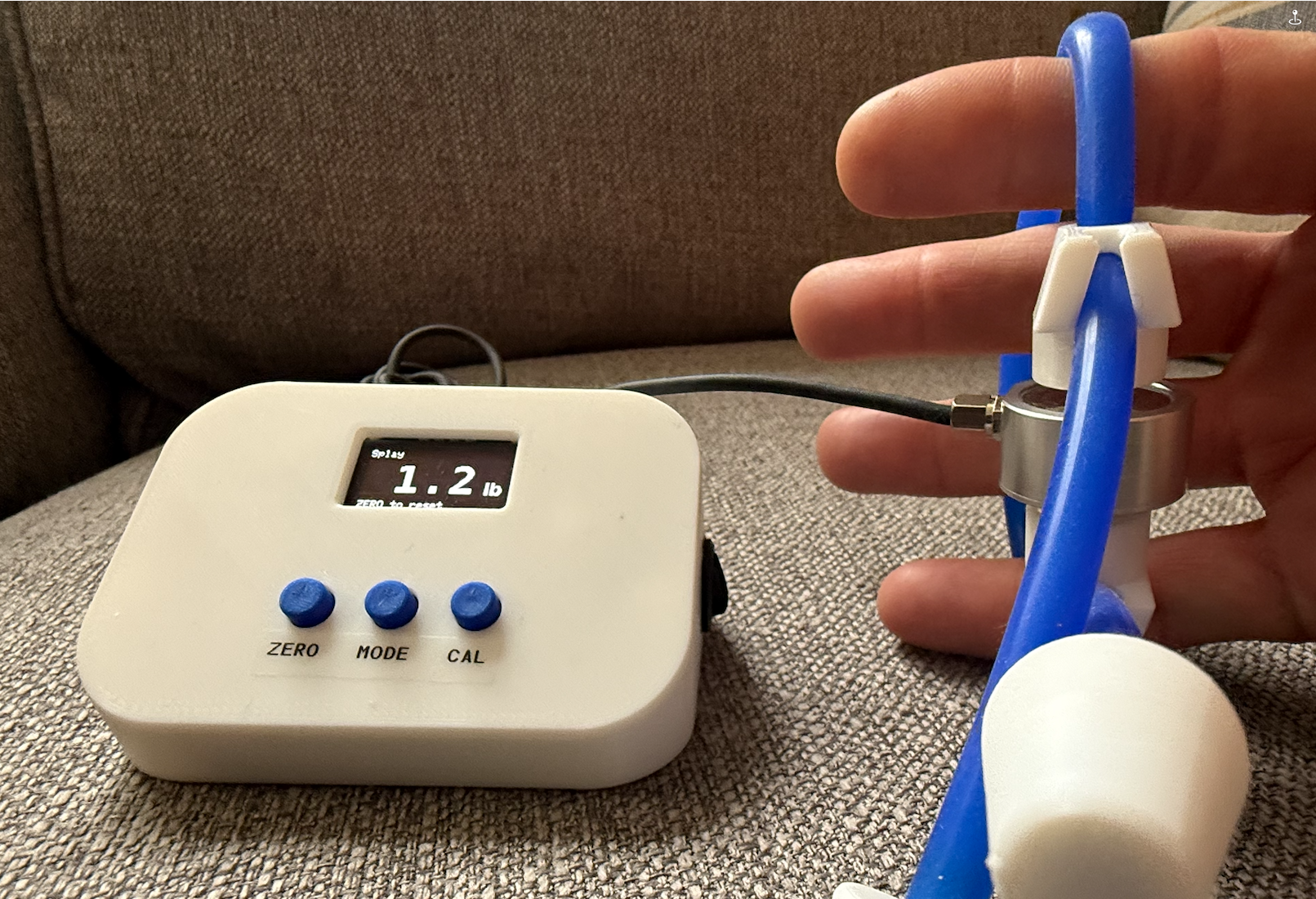
The Splayometer is the first clinical dynamometer purpose-built for measuring finger and hand extension and abduction force — delivering the objectivity, repeatability, and precision that rehabilitation demands.
Precise measurements of muscle strength in fingers and hands are fundamental to evaluation and treatment of functional deficits related to injury, paralysis, degradation, aging or other conditions.
Instruments for measuring grip strength and pinch force have been in clinical use for decades. But no commercial tool exists for the opposite motion — the force generated when fingers extend, spread, or open the hand against resistance.
Without an objective instrument, clinicians are forced to rely on manual muscle testing: a subjective, examiner-dependent method that introduces inter-rater variability and limits the reliability of clinical documentation.
"No prior commercial instrument exists for measuring extension or abduction force of the fingers or hand. The Splayometer addresses this gap directly."
Therapists resist motion with their own hands and assign a grade — introducing variability, limiting repeatability, and compromising documentation quality.
The Splayometer delivers a precise, reproducible numerical force reading in pounds or Newtons — the same standard used for grip and pinch assessment.
Baseline documentation, progress tracking, outcome measurement, and medico-legal reporting — all grounded in quantitative evidence.
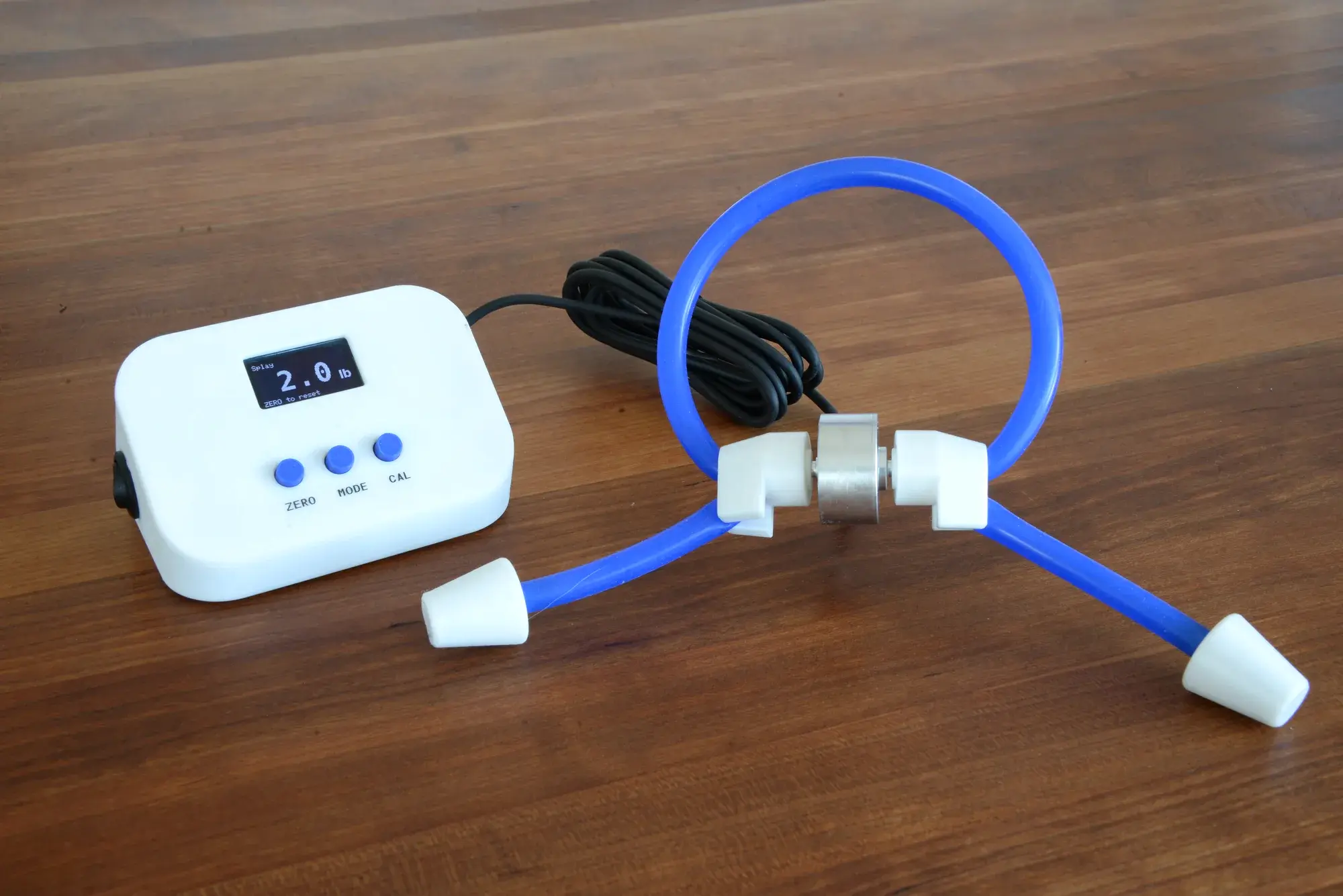
The Splayometer measures the tensile force generated when a patient pushes fingers apart, extends a finger away from the thumb, or opens the hand against resistance. It is available in digital and analog configurations.
Fig. 1 — Digital model: load cell with wired numeric display and interchangeable finger ring attachments.
All attachments connect via a common twist-lock quick-release mechanism, enabling rapid changeover between measurement tasks without tools.
Hollow silicone rings sized for each digit — index through pinky and thumb. The patient inserts one finger per ring; the Splayometer measures the tensile force between them as they spread apart.
A larger flexible loop that encircles all four fingers or the entire hand, enabling measurement of whole-hand extension and abduction force. Available in multiple sizes.
A 90-degree turn locks or releases any attachment member. Clinicians can switch between fingers or swap to the hand loop mid-session without interrupting workflow.
Fig. 3 — Hand loop attachment for whole-hand extension measurement.
Digital and analog variants share the same attachment system and measurement approach, offering flexibility to match clinical workflow and preference.
A cylindrical load cell connected by wire to a battery-powered display module. Delivers a precise numerical force reading with tare/zero and calibration functions. The separate display and load cell allow flexible positioning during measurement.
A micro-pneumatic cylinder converts spreading force into a vacuum, read directly on a dial indicator mounted to the device body. No battery or electronics required. Compact and ideal for simple finger and hand extension assessment.
The Splayometer fits naturally into existing hand assessment protocols with a straightforward, repeatable procedure.
Choose the appropriate finger rings for the digit pair being assessed, or attach the hand loop for whole-hand measurement.
The patient inserts the target digit and thumb (or two fingers) into the rings. The load cell sits in the direct force path between them.
The patient extends or spreads the digits apart. The device displays the peak force achieved during the trial.
Repeat three trials, record the average or maximum, and document objective, quantitative force data for clinical records.
The Splayometer supports every phase of hand rehabilitation assessment — from initial evaluation through discharge planning.
We are currently in the pre-production phase. Clinicians, researchers, and distributors are welcome to reach out with inquiries.