Conditions Where Extension Measurement Matters
A clinical reference to the diagnoses, injuries, and rehabilitation contexts in which quantitative extension and abduction force data answers a question that grip and pinch dynamometry cannot.
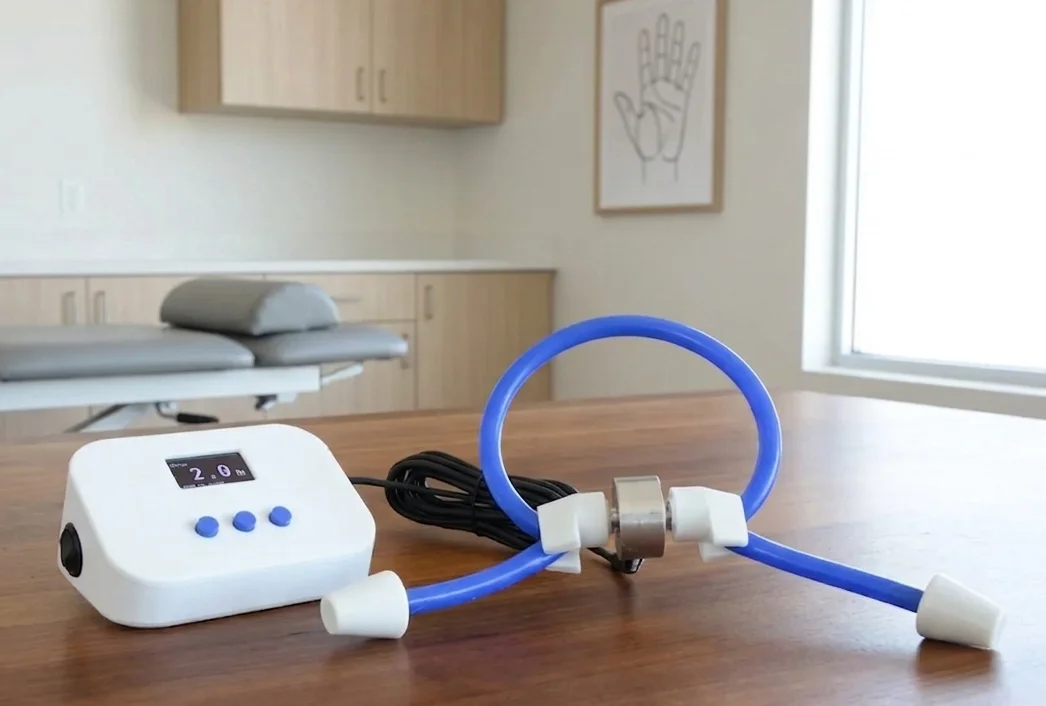
Grip Can Be Normal While Extension Is Severely Impaired
Extension and abduction are structurally independent from flexion and compression — different muscles, different nerves, different tendons. A patient with a normal grip dynamometer reading can have a 50% or greater deficit in interosseous hand spread, and no instrument has existed to document it.
In hand surgery and rehabilitation, the "grip-preserved" pattern is routine. Radial nerve palsy leaves all flexors untouched — a patient can grip a dynamometer normally while being unable to open the hand.1314 Ulnar nerve injury spares median-innervated flexor digitorum profundus to digits 2–3 and all flexor digitorum superficialis — grip strength on a standard dynamometer can test within normal range while interossei and lumbricals are weak or paralyzed.1323
Manual muscle testing — the current standard for assessing extension — produces an ordinal 0–5 grade that is inherently examiner-dependent. Its reliability is well-characterized and limited, particularly at the low end of the scale where early motor recovery lives.1245
Grip dynamometers and pinch gauges have long provided reliable quantitative data for compressive and adductive force.15 Extension and abduction have had no equivalent.
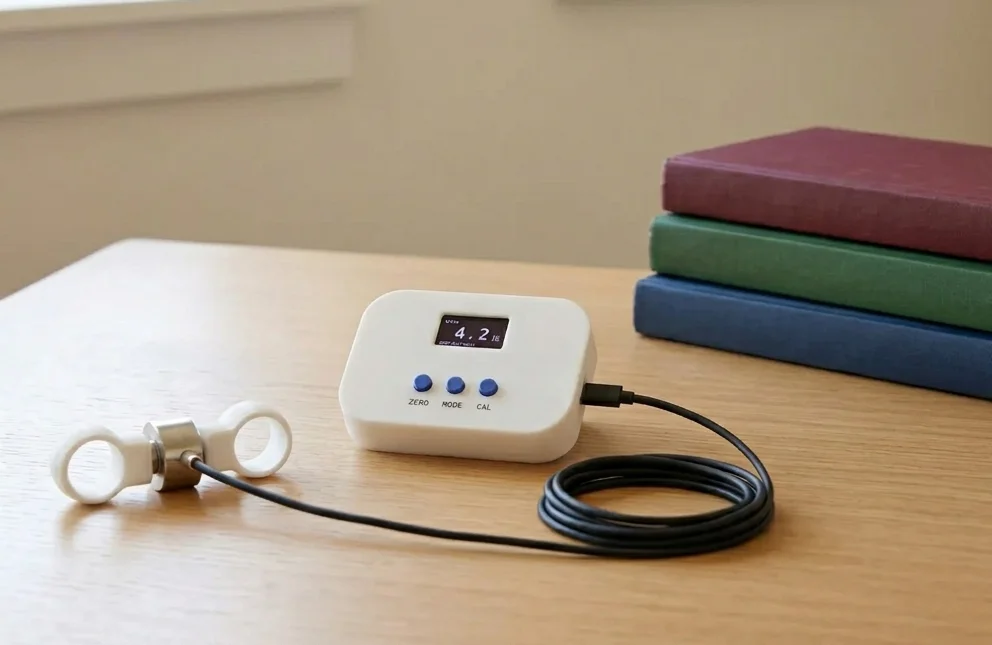
Composite Flexion
Flexor digitorum profundus, flexor digitorum superficialis, flexor pollicis longus — median and ulnar innervated. Compressive force.
Tip and Lateral Adduction
Thumb flexor and adductor muscles opposing the index. Not a measure of extensor or abductor force.
Extension & Abduction
Extrinsic extensors (EDC, EIP, EDM, EPL, EPB, APL), dorsal and palmar interossei, lumbricals, abductor pollicis. The muscles grip and pinch never assess.
Quick Reference
The specific extension and abduction deficit associated with each condition, and the reason standard grip testing fails to detect it.
| Condition | Primary Movement Affected | Why Grip Can Test Normal | Key Clinical Audience |
|---|---|---|---|
| Ulnar nerve injury | Finger abduction; MCP extension via interossei | Median-innervated flexors remain intact | CHT, Surgeon |
| Radial nerve palsy | All finger and wrist extension | All flexors are median/ulnar innervated | CHT, Surgeon |
| Extensor tendon repair | Extension at the zone of injury | Flexor tendons are unaffected | CHT, Surgeon |
| Stroke (CVA) | Finger and hand extension | Flexor spasticity preserves or exaggerates grip | Neuro Rehab |
| Cervical SCI (C6–C7) | Active finger extension; intrinsics | Tenodesis grip is preserved | Neuro Rehab |
| Dupuytren's release | Finger extension (4th, 5th digits) | Flexors are not involved in the pathology | CHT, Surgeon |
| Peripheral neuropathy | Intrinsic muscle function | Extrinsic flexors affected later (distal-to-proximal pattern) | CHT, Neurology |
| Musician overuse / dystonia | Individual finger independence | Gross grip strength is typically unaffected | Performing Arts Med |
| Mallet finger | DIP extension | Composite flexion is intact | CHT |
| Rheumatoid arthritis (hand) | Extension; ulnar drift correction | Early grip is often preserved | CHT, Surgeon |
| Fracture fixation | Extension (adhesion/stiffness) | Flexor mechanism often uninvolved | CHT, Surgeon |
| Nerve graft / transfer | Extension (slow reinnervation) | Flexors may recover first | CHT, Surgeon |
Peripheral Nerve Injuries
Peripheral nerve lesions produce the textbook example of the grip-preserved extension deficit. Because flexor and extensor compartments are innervated by different nerves, a single nerve lesion can devastate extension or abduction while leaving grip strength intact.1314
Ulnar nerve injury / cubital tunnel syndrome
- Affected structures
- All 4 dorsal and 3 palmar interossei, 4th and 5th lumbricals, adductor pollicis, hypothenar muscles, and flexor digitorum profundus to digits 4–5.13
- Extension / abduction deficit
- Loss of finger abduction, weakened finger adduction, and — in severe cases — "claw hand" posture of the 4th and 5th digits. MCP extension contributed by the interossei is lost.23
- Why grip can be normal
- Flexor digitorum profundus to digits 2–3 and all flexor digitorum superficialis muscles remain median-innervated — grip force transmitted through these remains intact. Ulnar-innervated FDP to digits 4–5 weakens, but overall grip dynamometry can still test within normal range.14
- Splayometer value
- Quantifies interosseous and abductor weakness invisible to grip or pinch testing. Supports serial tracking of reinnervation following decompression or nerve repair.
Radial nerve palsy / Saturday night palsy
- Affected structures
- All wrist extensors (ECRL, ECRB, ECU), finger extensors (EDC, EIP, EDM), thumb extensors (EPL, EPB, APL), and supinator.13
- Extension / abduction deficit
- Complete wrist drop, inability to extend fingers at the MCP joints, and loss of thumb extension — a functionally devastating pattern.
- Why grip can be normal
- All flexor muscles are median- or ulnar-innervated and entirely spared. A patient with a radial nerve palsy can produce near-normal grip force on a standard dynamometer while being unable to voluntarily open the hand.14
- Splayometer value
- Documents the severity of the extension deficit and tracks recovery during the long process of nerve regeneration. Provides objective milestone data for prognosis, orthotic decisions, and decisions about secondary tendon transfer.
Median nerve injury / severe carpal tunnel syndrome
- Affected structures
- Thenar muscles (opponens pollicis, abductor pollicis brevis, flexor pollicis brevis superficial head), 1st and 2nd lumbricals.13
- Extension / abduction deficit
- Loss of thumb opposition and palmar abduction. In severe carpal tunnel syndrome, thenar wasting reduces thumb-index web-space function.
- Why grip can be normal
- Ulnar-innervated intrinsics and FDP to digits 4–5 compensate; grip dynamometry may test only mildly reduced while thumb abduction force is severely diminished.
- Splayometer value
- Quantifies thumb abduction force — particularly useful for tracking thenar reinnervation following carpal tunnel release.
Posterior interosseous nerve (PIN) syndrome
- Affected structures
- Finger and thumb extensors (EDC, EIP, EDM, EPL, EPB, APL). ECRL is usually spared, so wrist extension is partially preserved but deviates radially.13
- Extension / abduction deficit
- Inability to extend fingers at the MCP joints; wrist extension is present but with radial deviation.
- Why grip can be normal
- All flexors are intact.
- Splayometer value
- Isolates and quantifies the specific extension deficit caused by PIN compression, distinct from higher radial nerve lesions, and documents recovery following decompression.
Tendon Injuries & Repairs
Extensor tendon injuries affect only the dorsal apparatus; the palmar flexor system is entirely unaffected. Extension force recovery is therefore the defining rehabilitation endpoint, and its measurement is where the gap is most obvious.1025
Extensor tendon repair (Zones I–VIII)
- Affected structures
- Depends on zone. Zone I–II (mallet, boutonniere) affects DIP/PIP extension; Zone V–VII affects MCP extension; Zone VIII affects wrist extension.12
- Extension / abduction deficit
- Specific to the zone of injury. Post-repair, extension force returns gradually over 8–12 weeks as the tendon heals and controlled mobilization progresses.10
- Why grip can be normal
- Flexor tendons lie on the palmar side and are completely uninvolved in dorsal extensor injury.
- Splayometer value
- Tracks extension force recovery during the critical post-repair rehabilitation window. Provides objective data for advancing therapy — for example, the transition from passive to active to resistive exercise in early active motion protocols.25
Mallet finger (Zone I extensor injury)
- Affected structures
- Terminal extensor tendon at the DIP joint — rupture or avulsion fracture of the distal phalangeal insertion.12
- Extension / abduction deficit
- Inability to actively extend the DIP joint; characteristic droop of the fingertip.
- Why grip can be normal
- Grip involves composite flexion; the mallet deformity does not affect flexor strength.
- Splayometer value
- Measures returning DIP extension force at the individual-digit level during recovery.
Sagittal band rupture / extensor subluxation
- Affected structures
- Sagittal band at the MCP joint; the extensor tendon subluxes ulnarly — most commonly at the middle finger.21
- Extension / abduction deficit
- Weakened or absent active MCP extension of the affected digit; the patient may report snapping over the knuckle.
- Splayometer value
- Quantifies the extension deficit pre- and post-reconstruction at the individual digit.
Flexor tendon repair (relevance)
- Clinical note
- While the Splayometer's primary role is in extension measurement, post-flexor-repair protocols sometimes need to confirm that extension force is not excessive — because over-aggressive extension can rupture a healing flexor repair. Controlled extension force measurement can support safe rehabilitation progression in this context.11
Neurological Conditions
In central and peripheral neurological disease, extension is typically the last function to return — and the easiest to miss. Ordinal MMT grading collapses the full range of meaningful clinical change into a handful of grades.12
Stroke (CVA) with upper-extremity involvement
- Affected structures
- Varies by lesion. An upper motor neuron pattern typically produces flexor hypertonicity — the hand closes into a fist. Extension is the most impaired movement and the slowest to recover.16
- Extension / abduction deficit
- Often severe. Patients may have no functional extension for weeks to months post-stroke. When extension returns, the gains are incremental and can be too subtle for MMT to detect — a patient producing 0.3 lbs of extension force still scores MMT grade 1, the same as a trace flicker.17
- Why grip can be normal or elevated
- Flexor spasticity can produce high grip readings. A patient with a strong grip reading may be completely unable to voluntarily open the hand.
- Splayometer value
- Detects early motor return in extension before it is visible to MMT. Documents incremental recovery, motivates patients by showing measurable progress, and supports the clinical justification for continued therapy.
Cervical spinal cord injury (SCI)
- Affected structures
- Depends on level. In C6 SCI, wrist extension is preserved but finger extension and intrinsics are lost; in C7, finger extension may be partially preserved, with intrinsics still lost.20
- Extension / abduction deficit
- Loss of finger extension and/or intrinsic hand function depending on level.
- Why grip can be normal
- Tenodesis grip — passive finger flexion driven by active wrist extension — can produce functional grip force at the C6 level while active finger extension is entirely absent.
- Splayometer value
- Quantifies any returning active extension, which is critical for functional prognosis and orthotic decision-making.
Peripheral neuropathy (diabetic, toxic, inflammatory)
- Affected structures
- Typically a distal-to-proximal ("stocking-glove") pattern. Intrinsic hand muscles are often affected early.
- Extension / abduction deficit
- Gradual weakening of the interossei and lumbricals — subtle and progressive, easily missed by MMT until significantly advanced.2
- Why grip can be normal
- Extrinsic flexors (forearm-based) are affected later than intrinsic hand muscles. Grip can test normal while intrinsic function is deteriorating.
- Splayometer value
- Sensitive early detection of intrinsic muscle weakness. Longitudinal tracking of disease progression or treatment response.
Guillain-Barré syndrome (GBS) / CIDP
- Affected structures
- Ascending demyelination; hand intrinsics are affected early in recovery, as part of the distal weakness pattern.
- Extension / abduction deficit
- Can be profound during the acute phase; precise recovery tracking is essential.
- Splayometer value
- Documents motor recovery trajectory with precision that supports discharge planning and long-term prognosis.
Degenerative & Contracture Conditions
In degenerative and contracture conditions of the hand, extension is often the pathology — and the single most important outcome measure for intervention.679
Dupuytren's contracture (pre- and post-release)
- Affected structures
- Palmar fascia contracts, pulling fingers into flexion (typically the 4th and 5th digits). MCP and PIP joints progressively lose extension.7
- Extension / abduction deficit
- The defining feature of the disease. Extension deficit is the diagnosis. Following fasciectomy, needle fasciotomy, or collagenase injection, extension recovery is the primary outcome measure.69
- Why grip can be normal
- Flexor muscles and tendons are not involved in Dupuytren's pathology. Grip strength is typically preserved.
- Splayometer value
- Pre-intervention: quantifies the degree of extension force deficit. Post-intervention: tracks objective extension recovery — the single most important outcome measure for this condition.8
Rheumatoid arthritis (hand involvement)
- Affected structures
- Synovitis destroys joint surfaces, tendons, and supporting structures — resulting in ulnar drift at the MCP joints, swan-neck and boutonniere deformities, and extensor tendon rupture.
- Extension / abduction deficit
- Progressive loss of extension secondary to joint destruction, tendon attenuation, and muscle imbalance.
- Why grip can be normal early
- In early RA, grip strength may be preserved while subtle extension and abduction weakness is already developing.
- Splayometer value
- Early detection of extension deficit as a disease activity marker. Post-surgical outcome tracking after arthroplasty or tendon reconstruction.
Osteoarthritis — CMC and DIP joints
- Affected structures
- Cartilage degeneration, osteophyte formation, joint stiffness.
- Extension / abduction deficit
- Reduced thumb abduction range and force at the CMC joint; DIP stiffness at affected digits.
- Splayometer value
- Quantifies functional thumb abduction strength, tracks response to conservative treatment (splinting, exercise), and documents post-surgical outcomes following CMC arthroplasty.
Performing Arts & Sport-Specific
Performers and athletes live at the high-performance end of hand function, where deficits that are undetectable on routine testing can still be career-limiting.18
Musician hand injuries
- Context
- Pianists, guitarists, string players, and wind instrumentalists depend on individual finger independence, extension control, and precise abduction/adduction. Even small deficits can be career-ending.
- Common conditions
- Focal dystonia, overuse tendinopathy, nerve compression (especially ulnar at Guyon's canal), and ligament sprains.18
- Extension / abduction deficit
- Often subtle — functionally devastating but invisible on standard testing.
- Splayometer value
- Measures individual digit extension force with precision that matches the demands of performance. Provides objective return-to-playing criteria rather than subjective clearance.
Rock climbing injuries
- Context
- Climbers rely heavily on finger flexor strength (crimp and open-hand grip), but extension strength is critical for injury prevention and balanced recovery from pulley injuries.
- Common conditions
- A2 and A4 pulley ruptures, flexor tendon bowstringing, and lumbrical shifts.
- Splayometer value
- Assesses extension strength during recovery and provides data for balanced strength training — quantifying the flexor-to-extensor ratio that climbing coaches and therapists now track.
Ball-sport athletes (basketball, football, volleyball)
- Context
- Finger hyperextension injuries, "jammed" fingers, and MCP dislocations.
- Extension / abduction deficit
- Post-injury extension weakness affects ball-handling, catching, and throwing.
- Splayometer value
- Objective return-to-play data for finger extension strength, rather than clinician-judgment clearance alone.
Post-Surgical Rehabilitation
Across hand surgery, extension recovery often lags flexion — and often defines whether an intervention is considered functionally successful.
Joint replacement / arthroplasty (MCP, PIP)
- Extension / abduction deficit
- Post-arthroplasty extension is a primary rehabilitation goal.
- Splayometer value
- Tracks extension force recovery through the rehabilitation protocol.
Fracture fixation (phalanx, metacarpal)
- Extension / abduction deficit
- Post-fixation stiffness and tendon adhesion commonly limit extension more than flexion.
- Why grip can be normal
- Flexor tendons are often outside the fracture zone.
- Splayometer value
- Documents extension recovery and guides progression of the mobilization protocol.
Nerve grafting / nerve transfer
- Extension / abduction deficit
- Reinnervation is slow (approximately 1 mm per day), and extension recovery may take 6–18 months.
- Splayometer value
- Detects the earliest signs of motor reinnervation in extension — critical for prognosis and for decisions about further surgical intervention.
Bibliography
Anchor references from the hand surgery, hand therapy, and rehabilitation literature supporting the clinical claims on this page.
- Florence JM, Pandya S, King WM, et al. Intrarater reliability of manual muscle test (Medical Research Council scale) grades in Duchenne's muscular dystrophy. Physical Therapy. 1992;72(2):115–126. PubMed: 1549632
- Wadsworth CT, Krishnan R, Sear M, Harrold J, Nielsen DH. Intrarater reliability of manual muscle testing and hand-held dynametric muscle testing. Physical Therapy. 1987;67(9):1342–1347. PubMed: 3628487
- Bohannon RW. Reliability of hand-held dynamometry: a systematic review. Isokinetics and Exercise Science. 2018;26(1):5–16. doi:10.3233/IES-182178
- Cuthbert SC, Goodheart GJ Jr. On the reliability and validity of manual muscle testing: a literature review. Chiropractic & Osteopathy. 2007;15:4. PubMed: 17341308
- Hurst LC, Badalamente MA, Hentz VR, et al. Injectable collagenase clostridium histolyticum for Dupuytren's contracture. New England Journal of Medicine. 2009;361(10):968–979. doi:10.1056/NEJMoa0810866
- Hindocha S, Stanley JK, Watson JM, Bayat A. Revised Tubiana's staging system for assessment of disease severity in Dupuytren's disease—preliminary clinical findings. Hand (NY). 2008;3(2):164–169. PubMed: 18780081
- Beaudreuil J, Allard A, Zerkak D, et al. Uníté Rhumatologique des Affections de la Main (URAM) scale: development and validation of a tool to assess Dupuytren's disease-specific disability. Arthritis Care & Research. 2011;63(10):1448–1455. doi:10.1002/acr.20564
- van Rijssen AL, ter Linden H, Werker PMN. Five-year results of a randomized clinical trial on treatment in Dupuytren's disease: percutaneous needle fasciotomy versus limited fasciectomy. Plastic and Reconstructive Surgery. 2012;129(2):469–477. doi:10.1097/PRS.0b013e31823aea95
- Evans RB. Immediate active short arc motion following extensor tendon repair. Journal of Hand Surgery (Am). 1994;19(2):253–259. PubMed: 7959826
- Strickland JW. Development of flexor tendon surgery: twenty-five years of progress. Journal of Hand Surgery (Am). 2000;25(2):214–235. doi:10.1053/jhsu.2000.jhsu25a0214
- Doyle JR, Botte MJ. Surgical Anatomy of the Hand and Upper Extremity. Philadelphia, PA: Lippincott Williams & Wilkins; 2003. (Standard anatomy reference for extensor zone classification and sagittal band anatomy.)
- Wolfe SW, Pederson WC, Kozin SH, Cohen MS, eds. Green's Operative Hand Surgery. 8th ed. Philadelphia, PA: Elsevier; 2020. (Gold-standard reference for peripheral nerve innervation, grip-preserved palsy patterns, and extensor/intrinsic loss.)
- Skirven TM, Osterman AL, Fedorczyk JM, Amadio PC, Feldscher SB, Shin EK, eds. Rehabilitation of the Hand and Upper Extremity. 7th ed. Philadelphia, PA: Elsevier; 2020. (Authoritative text on hand rehabilitation, intrinsic recovery, and the functional mechanics of extension.)
- Mathiowetz V, Weber K, Volland G, Kashman N. Reliability and validity of grip and pinch strength evaluations. Journal of Hand Surgery (Am). 1984;9(2):222–226. doi:10.1016/S0363-5023(84)80146-X
- Fugl-Meyer AR, Jääskö L, Leyman I, Olsson S, Steglind S. The post-stroke hemiplegic patient: I. A method for evaluation of physical performance. Scandinavian Journal of Rehabilitation Medicine. 1975;7(1):13–31. PubMed: 1135616
- Lyle RC. A performance test for assessment of upper limb function in physical rehabilitation treatment and research. International Journal of Rehabilitation Research. 1981;4(4):483–492. PubMed: 7333761
- Altenmüller E, Jabusch HC. Focal dystonia in musicians: phenomenology, pathophysiology, triggering factors, and treatment. European Journal of Neurology. 2010;17(Suppl 1):31–36. doi:10.1111/j.1468-1331.2010.03048.x
- Kirshblum SC, Burns SP, Biering-Sørensen F, et al. International Standards for Neurological Classification of Spinal Cord Injury (revised 2019). Journal of Spinal Cord Medicine. 2019;42(Suppl 1):S1–S310. doi:10.1080/10790268.2019.1586822
- Rayan GM, Murray D. Classification and treatment of closed sagittal band injuries. Journal of Hand Surgery (Am). 1994;19(4):590–594. doi:10.1016/0363-5023(94)90262-3
- StatPearls. Cubital Tunnel Syndrome. Treasure Island, FL: StatPearls Publishing; updated 2023. NCBI Bookshelf: NBK448200
- Collocott SJF, Kelly E, Ellis RF. Optimal early active mobilisation protocol after extensor tendon repairs in zones V and VI: a systematic review of the literature. Hand Therapy. 2018;23(1):3–18. doi:10.1177/1758998317729713
This page is provided for clinical information. References were selected as anchor citations — Peter and the Splayometer clinical team should verify each DOI and refine the bibliography before final publication. Additional primary literature exists for each condition; the citations above are a starting point rather than a complete review.
Questions About a Specific Condition or Workflow?
We welcome inquiries from hand therapists, surgeons, researchers, and clinical educators.